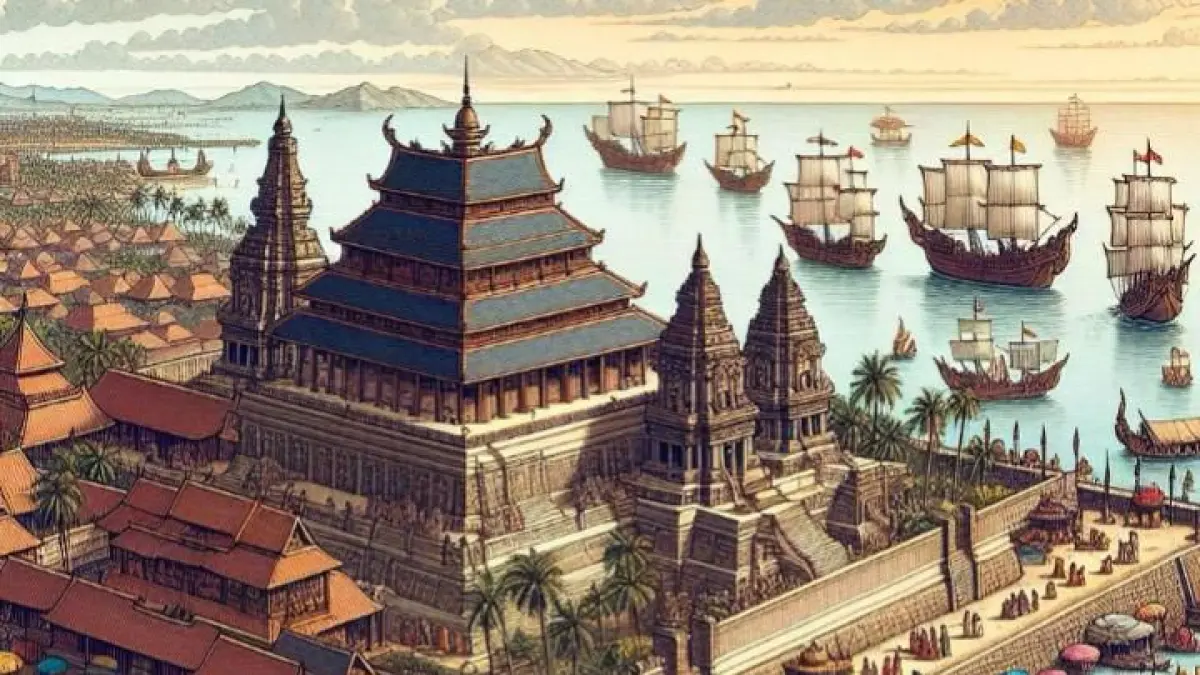
TRENGGALEK - For centuries, the Nusantara kingdoms played a crucial role in shaping Southeast Asia’s political and economic landscape. Powerful empires such as the Majapahit Empire and Srivijaya Empire transformed the Indonesian archipelago into one of the world’s most important maritime centers long before the modern nation of Indonesia existed.
Historians say the success of these Nusantara kingdoms was driven by strategic geography, strong naval fleets, and control of major trade routes. Their influence extended across present-day Indonesia, Malaysia, Singapore, Thailand, and parts of the Philippines, making them dominant regional powers for centuries.
The Srivijaya Empire emerged around the 7th century in Sumatra and quickly became a thriving maritime kingdom. Positioned near the Malacca Strait, Srivijaya benefited from international trade between China, India, and the Middle East. Traders traveling across Asia relied on its ports for supplies, taxation systems, and commercial exchanges.
Beyond commerce, Srivijaya was also recognized as a center for Buddhist scholarship. Historical accounts mention that monks from China visited the kingdom to study Buddhist teachings before continuing their journeys to India. This helped establish Srivijaya as both a religious and economic powerhouse in Southeast Asia.
Several centuries later, the Majapahit Empire rose in East Java and became one of the most influential kingdoms in Nusantara history. Founded in the late 13th century, Majapahit expanded rapidly through military campaigns and diplomatic alliances.
The kingdom reached its peak under King Hayam Wuruk and Prime Minister Gajah Mada. During this period, Majapahit controlled extensive territories and strengthened trade relations with neighboring regions. Historians often describe the empire as one of the largest and most sophisticated political entities in Southeast Asian history.
Majapahit’s cultural achievements also left a lasting impact. Literature, architecture, and governance systems developed during the kingdom’s golden age continue to be studied by scholars today. Ancient temples and manuscripts from the era reveal advanced knowledge in politics, religion, and art.
The decline of the Nusantara kingdoms occurred gradually as regional dynamics changed. Srivijaya weakened due to foreign invasions and competition from emerging trading ports. Majapahit later declined because of internal political disputes and the rise of Islamic kingdoms throughout the archipelago.
Although these empires eventually disappeared, their legacy remains deeply connected to Indonesian identity. The history of the Nusantara kingdoms is still celebrated through education, tourism, and archaeological preservation efforts across the country.
Modern historians believe the achievements of Srivijaya and Majapahit demonstrate how Southeast Asia became a vital hub for global trade centuries before European colonial powers arrived in the region.
Editor : Ingge Nayla Ayu KarinaSumber : DIOLAH, youtube