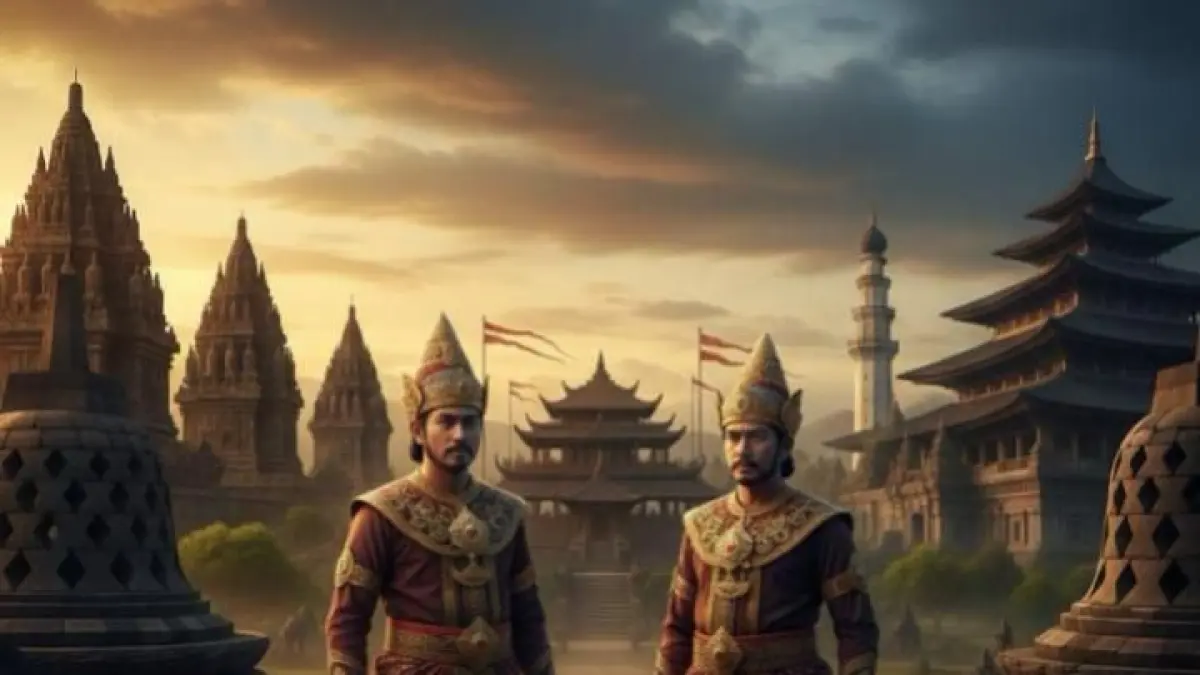
TRENGGALEK - The Nusantara kingdoms once stood among the most powerful civilizations in Southeast Asia, controlling international trade routes and influencing regional culture for centuries. Empires such as the Srivijaya Empire and Majapahit Empire helped transform the Indonesian archipelago into a strategic center for commerce, diplomacy, and religion long before the colonial era began.
Experts believe the success of these Nusantara kingdoms was closely linked to their dominance over maritime trade. Located between the Indian Ocean and the South China Sea, the archipelago became a gateway for merchants traveling between China, India, and the Middle East. Spices, textiles, ceramics, and precious metals flowed through the region, bringing enormous wealth to local rulers.
The Srivijaya Empire was among the earliest major powers in Nusantara history. Based in Sumatra around the 7th century, the kingdom expanded its influence by controlling important sea routes near the Malacca Strait. This allowed Srivijaya to become a dominant maritime empire with economic and political influence across Southeast Asia.
Historical records also describe Srivijaya as an important Buddhist center. Travelers and scholars from different parts of Asia visited the kingdom to study religion and culture. The empire’s strong relationship with neighboring regions helped establish diplomatic connections that strengthened its position in international trade.
Several hundred years later, the Majapahit Empire emerged in East Java and became one of the most celebrated kingdoms in Indonesian history. Founded at the end of the 13th century, Majapahit expanded rapidly under the leadership of influential rulers and military figures.
The kingdom achieved its greatest power during the reign of Hayam Wuruk, supported by the famous commander Gajah Mada. Historical texts suggest Majapahit controlled large parts of the archipelago and maintained active trade relations with kingdoms across Asia.
Majapahit was not only known for military strength but also for cultural development. Literature, architecture, and traditional governance flourished during its golden age. Many historians consider the kingdom a symbol of early Indonesian unity because of its vast territorial influence.
The decline of the Nusantara kingdoms happened gradually as new political and economic forces emerged. Srivijaya lost influence after foreign invasions disrupted trade routes, while Majapahit weakened because of internal conflict and the expansion of Islamic sultanates throughout the region.
Even after their fall, the legacy of these kingdoms continues to shape Indonesian culture and national identity. Ancient temples, inscriptions, and archaeological sites remain important reminders of a period when Nusantara civilizations played a major role in connecting Asia through maritime trade.
Today, growing global interest in Southeast Asian history has brought renewed attention to the achievements of Srivijaya and Majapahit. Researchers view the Nusantara kingdoms as evidence that the Indonesian archipelago was once home to advanced and influential civilizations with international reach.
Editor : Ingge Nayla Ayu Karina