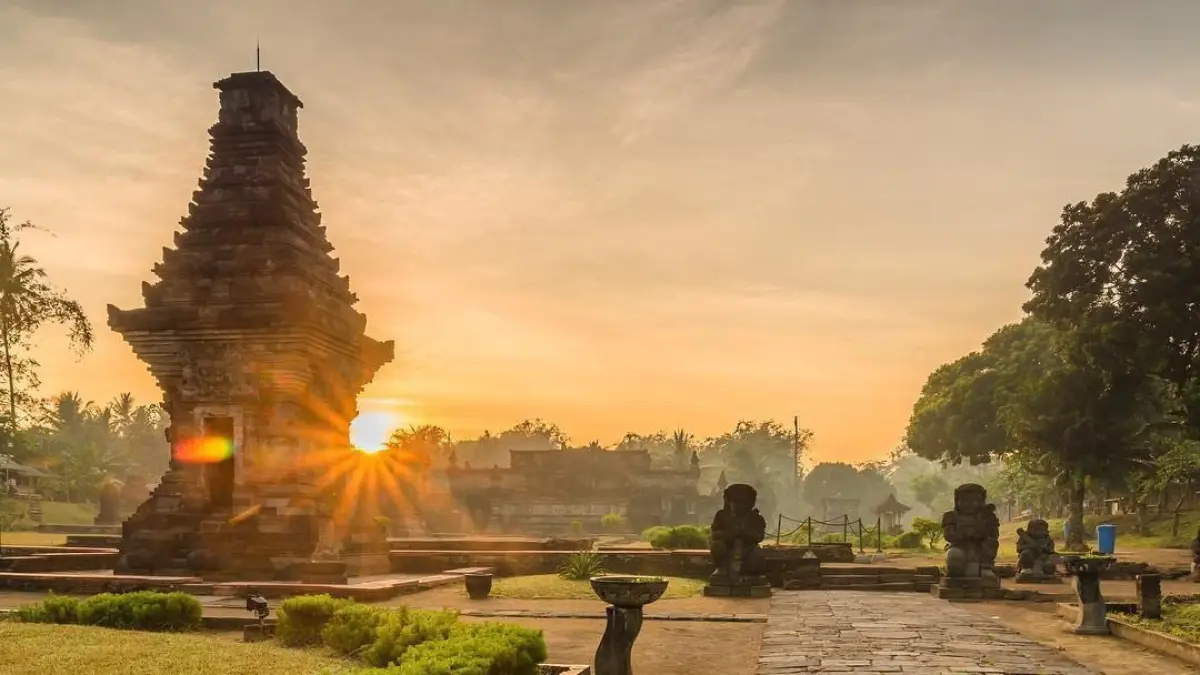
JAKARTA - The Majapahit Kingdom is widely recognized as the largest and most powerful empire ever to unite most of the Indonesian archipelago. Founded in 1293 by Raden Wijaya, Majapahit grew into a dominant maritime kingdom under the leadership of Hayam Wuruk and Mahapatih Gajah Mada before eventually collapsing due to civil war, political conflict, and the rise of new Islamic powers in Java.
The kingdom’s influence once stretched far beyond Java, reaching Sumatra, the Malay Peninsula, Tumasik (Singapore), parts of Thailand, and even the Philippines. Majapahit became famous for its military strength, sophisticated trade network, and the legendary Palapa Oath sworn by Gajah Mada to unite the entire archipelago.
At its peak, Majapahit controlled major maritime trade routes and became one of Southeast Asia’s richest kingdoms. However, internal conflict and economic decline slowly weakened the empire until it was finally replaced by the Islamic Sultanate of Demak.
The Rise of the Majapahit Kingdom After the Fall of Singasari
The history of the Majapahit Kingdom began after the collapse of the Singasari Kingdom in East Java. At the time, Singasari was ruled by King Kertanegara, who aimed to expand his influence across Southeast Asia.
In 1292, a regent from Gelang-gelang named Jayakatwang launched a rebellion against Singasari. The attack succeeded and Kertanegara was killed, causing the kingdom to collapse.
Following the fall of Singasari, Kertanegara’s son-in-law, Raden Wijaya, fled across the Madura Strait. He later sought assistance from Arya Wiraraja, the ruler of Sumenep, while also taking advantage of the arrival of Mongolian troops sent by Kublai Khan of the Yuan Dynasty.
The Mongols originally came to punish Kertanegara for insulting the Yuan envoy. However, Raden Wijaya cleverly used their military support to defeat Jayakatwang. After Jayakatwang was overthrown, Raden Wijaya turned against the Mongol forces and forced them to retreat from Java.
In 1293, Raden Wijaya officially established the Majapahit Kingdom and was crowned as the first king with the title Prabu Kertarajasa Jayawardana. He ruled for 16 years until his death in 1309.
Majapahit initially controlled only parts of East Java, but Raden Wijaya focused on strengthening the kingdom’s military, political alliances, and administrative system. The capital was centered around the Trowulan area in present-day Mojokerto, East Java.
Gajah Mada and Hayam Wuruk Led Majapahit to Its Golden Age
After Raden Wijaya’s death, his son Jayanagara ruled Majapahit until 1328. His reign was marked by several rebellions, including the dangerous Ra Kuti rebellion, which successfully occupied the royal palace for a period of time.
Following Jayanagara’s death, the throne passed to his half-sister, Queen Tribhuwana Wijayatunggadewi, who ruled from 1328 to 1350. During her reign, Gajah Mada was appointed Mahapatih, or prime minister.
It was during this period that Gajah Mada took the famous Palapa Oath, declaring he would not enjoy worldly pleasures until the entire archipelago was united under Majapahit’s rule.
Majapahit reached its greatest glory under King Hayam Wuruk, who ruled from 1350 to 1389. Together with Gajah Mada, Hayam Wuruk expanded Majapahit’s influence across Southeast Asia and strengthened its position as a maritime empire.
Trade became the foundation of Majapahit’s wealth. The kingdom controlled important ports and trading routes connecting China, India, the Middle East, and Southeast Asia. Commodities such as spices, rice, gold, textiles, and ceramics flowed through Majapahit’s ports.
During Hayam Wuruk’s reign, Majapahit also experienced remarkable cultural development. Literary works such as the Negarakertagama by Mpu Prapanca documented the kingdom’s administration and territorial influence.
However, not all events during this era were peaceful. In 1357, the Bubat tragedy occurred when a planned royal marriage between Hayam Wuruk and Princess Dyah Pitaloka of the Sunda Kingdom ended in a deadly conflict after Gajah Mada demanded Sunda’s submission to Majapahit.
Civil War and the Rise of Demak Triggered Majapahit’s Collapse
Majapahit began to decline after Hayam Wuruk died in 1389. Leadership passed to his son-in-law Wikramawardhana, but the succession was challenged by Bhre Wirabhumi, Hayam Wuruk’s son from another line.
The dispute led to the Paregreg Civil War in 1404, a devastating conflict that weakened Majapahit politically and economically. Many territories outside Java broke away from Majapahit’s control during this period.
After Wikramawardhana’s death, Majapahit was ruled by Queen Suhita and later by Kertawijaya, also known as Brawijaya I. The kingdom continued to struggle with political instability and economic crisis.
At the same time, the Sultanate of Demak emerged as a new Islamic power on the north coast of Java. Founded by Raden Patah, believed to be the son of Brawijaya V, Demak gradually replaced Majapahit as the dominant political force in Java.
Majapahit eventually collapsed after being attacked twice by the Demak Sultanate. Although the kingdom disappeared politically, its cultural legacy survived through literature, architecture, inscriptions, and historical sites.
Several important remains from the Majapahit era still exist today, including Bajang Ratu Gate, Rat Temple, the Kudadu inscription, and the Canggu inscription. The story of Majapahit’s glory also lives on through the Negarakertagama, which remains one of the most important historical records of the kingdom.
Editor : Divka Vance Yandriana